EN
Quinty van Seccelen (2001) explores the space between body and mind. She wonders what kind of cosmos they share. Are they intimately connected, or are they strangers, still
waiting for a first encounter?
Her research begins with meditation, writing, and observing the body. Centring the lived experience of chronic illness, she investigates how physical experience shapes
perception, memory and mind. She approaches them by listening, walking alongside them, and allowing them to unfold into new spaces.
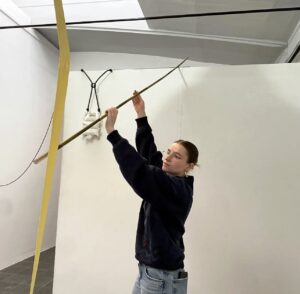
Working with materials such as latex, photography, and paint, she translates internal processes into physical forms. Her installations mirror and expand the spaces they inhabit, taking on a new identity through the presence of each visitor.
by engaging
the viewer’s body through texture, scale, and spatial relationships, the work invites an embodied encounter rather than a purely visual one. The work remains in constant dialogue with the body that enters it.
Her practice explores the porous boundary between the psychological and the corporeal, where sensations become tangible and the invisible takes on material form. By foregrounding the lived experience of chronic illness, she questions dominant understandings of health, presence, and embodiment. Each work is an attempt to make visible what usually remains beneath the surface.
NL
Quinty van Seccelen (2001) onderzoekt de ruimte tussen lichaam en geest. Ze vraagt zich af in welke kosmos zij samen bestaan. Zijn ze onlosmakelijk met elkaar verbonden, of zijn het vreemden die nog wachten op een eerste ontmoeting?
Haar onderzoek begint bij meditatie, schrijven en het observeren van het lichaam.
Vanuit de geleefde ervaring van chronische ziekte onderzoekt ze hoe lichamelijke ervaringen onze waarneming, herinnering en geest vormen. Ze benadert deze ervaringen door ernaar te luisteren, ernaast te lopen en ze de ruimte te geven zich te ontvouwen.
Met materialen als latex, fotografie en verf vertaalt ze innerlijke processen naar fysieke vormen. Haar installaties spiegelen en vergroten de ruimte die ze innemen en krijgen een nieuwe identiteit door de aanwezigheid van iedere bezoeker.
Door de toeschouwer zintuiglijk te prikkelen via textuur, schaal en ruimtelijke verhoudingen nodigt het werk uit tot een belichaamde ervaring, in plaats van een visuele. Het werk blijft voortdurend in dialoog met het lichaam dat de ruimte betreedt.
Haar praktijk onderzoekt de poreuze grens tussen het psychologische en het lichamelijke, waar sensaties tastbaar worden en het onzichtbare een materiële vorm aanneemt.
Door de geleefde ervaring van chronische ziekte centraal te stellen,
bevraagt ze dominante ideeën over gezondheid, aanwezigheid en belichaming. Elk werk is een poging zichtbaar te maken wat zich normaal gesproken onder de
oppervlakte bevindt.